Showing posts with label public policy. Show all posts

Sunday, February 16, 2025

Freaking Measles, Man

Yesterday during vespers I thought about reading philosophy, especially because there was a raft of new orders and policies that I hadn’t looked at yet, having spent the last couple days in knitting-and-napping mode as I fought off whatever is going around. One of the policies is about withholding federal funds for schools that have any sort of COVID-19 vaccination mandate. 

While I was writing some broad bullet points about how this is a nonsensical regulation on several fronts, I was noticing that the language positions the order in such a way that it scales easily, meaning that the specifics of the trigger (COVID-19) are not as central to the language as the condition of the trigger (vaccine mandates), and this could cause a lot of confusion simply in the way it is written, and it also opens the way to a broad interpretation. 

Of course, what I was most interested in is the balance of who sets policies of public health and what these policy “jurisdictions” mean for education. I was getting a good groove on the writing (no, I still haven’t picked up Community yet, thanks for noticing) when I decided to check in on the measles. 

Measles and polio vaccinations were largely lauded as a triumph of public health policy, and the public vaccination campaigns were successful in both cases exactly because they partnered with schools. Even Mary Baker Eddy (the founder of the Christian Scientists, the sect that holds that illness is god’s will) said that overall public health considerations were important enough to allow vaccination among CS followers. 

The twenty-first century anti-vax movement in the US created holes in the measles vaccine shield in some of the most privileged communities in the country, and we had an outbreak in 2014 in California, a public health emergency so dramatic that California reversed its long-standing allowance for “personal choice” exemption of childhood vaccinations, a policy of which it was quite proud, and overall a policy that was very on-brand for California. And all of a sudden I couldn’t remember the name of the county, or the name of the Governor who reversed the policy, and man, having a TBI is wild, but thank goodness there’s google.

I opened a search page for “What county had a measles outbreak in California in 2014.” I expected to have to sift thorough the Chicago 2024 outbreak (60 cases) because google likes recent results that are nearly accurate over more tightly controlled adherence to search terms, but instead I got a raft of results about the current, ongoing, right this very now, Gaines County, Texas measles outbreak of 48 cases, with half of those coming in the last three days. Gaines County is in rural west Texas near the Arizona border, and it has an eye-poppingly low childhood vaccination rate. The official tally is that 14% of the children are under vaccinated, but the record doesn’t reflect the very large percentage of Gaines County school age children who are homeschooled or enrolled in private schools. 

By then it was officially compline, but I was in no way ready for bed. I hadn’t moved. I was sitting very still, contemplating what a large-scale measles outbreak might look like for the United States.
 
Measles has an infection rate of 90% in the vulnerable: that means that 9 out of 10 unvaccinated people will get the measles if they are exposed to it. It’s wildly contagious. There is no treatment. Patients are usually contagious for 4 or 5 days before symptoms appear, and symptoms are notably a rash and a fever. Key treatments for an infected patient involve making sure hydration and minimum nutrition is maintained, and of course rest. The rash and fever usually clear up in 7-10 days, and patients usually recover fully in 2-3 weeks. What makes measles so rotten is the complications that come with it:
  • 1 in 5 patients ends up hospitalized.
  • 1 in 20 come down with pneumonia, the leading cause of measles-related death.  
  • 1 in 1000 develop brain swelling that leads to permanent deafness, convulsions, or intellectual disabilities.
  • 1-3 in 1000 patients dies due to respiratory or neurological complications. While measles is associated with children, anyone can get measles at any age.
The measles vaccine is only 56 years old. It was introduced in 1968, and was so effective that in 1978, the CDC set a measles elimination goal by 1982. A measles outbreak amongst the vaccinated in 1989 prompted the CDC to recommend a measles booster. In 2000, the US was declared measles free as a result of 25 years of high vaccination rates across the country.

I don’t have a clue how Covid or modern influenza affects the numbers. We haven’t really needed to know that, given the effectiveness of the vaccine and the presence of the shield (90+ percent vaccination rate is needed to maintain group immunity). I don’t know what a measles mutation might look like, or what it would mean for public health. Given how adept Covid seems to be at mutating, I’m not sure I want to see a measles variant that has made friends with Covid.

Freaking measles, man.

Of course, if you need to update your vaccination or your booster, please contact your local health department or health provider. The vaccine is widely available and affordable, possibly even free, and effective immunity occurs in less than 3 weeks.

Wednesday, August 30, 2023

Education in Virginia


VIRGINIA
The public schools enroll 1,274,000 students: 52% White, 23% African American, 13% Latino, and 6% Asian, with 40% living in poverty, and 8% learning English. The State spends $10,960 per pupil. (Most recent NCES data)

STATE CONSTITUTION
“That free government rests, as does all progress, upon the broadest possible diffusion of knowledge, and that the Commonwealth should avail itself of those talents which nature has sown so liberally among its people by assuring the opportunity for their fullest development by an effective system of education throughout the Commonwealth.” Va. Const. art. I, § 15.

“The General Assembly shall provide for a system of free public elementary and secondary schools for all children of school age throughout the Commonwealth, and shall seek to ensure that an educational program of high quality is established and continually maintained.” Va. Const. art. VIII, § 1.

“Standards of quality for the several school divisions shall be determined and prescribed from time to time by the Board of Education, subject to revision only by the General Assembly. The General Assembly shall determine the manner in which funds are to be provided for the cost of maintaining an educational program meeting the prescribed standards of quality, and shall provide for the apportionment of the cost of such program between the Commonwealth and the local units of government comprising such school divisions. Each unit of local government shall provide its portion of such cost by local taxes or from other available funds.” Va. Const. art. VIII, § 2.

MAJOR CASES
In 1994, in Scott v. Commonwealth, the Virginia Supreme Court declared education a fundamental right under the State constitution, but also held that the constitution does not require equal per-pupil funding or equal programs in school districts across the state. The Court concluded that “Section 2 addresses the two essential elements of quality education: standards and funding. By the terms of § 2, the General Assembly is empowered to make the final decision about both standards of quality and funding.

Monday, July 10, 2023

Save a Life. Open a library.

In his book Heat Wave: A Social Autopsy of Disaster in Chicago, Eric Klinenberg found that having social infrastructure in place was a life-saving mitigation, lowering the risk of death by 80 percent in the heat wave of 1995, the equivalent of having an air conditioner versus not having one. 

In the US, heat kills more Americans than any other weather-related disaster, and the climate crisis has been making these extreme events more deadly. Heat deaths have outpaced hurricane deaths in the country by more than 8-to-1 over the past decade, according to data tracked by the National Weather Service.

The evidence shows that social infrastructure is the most relevant and effective population-wide solution politicians can make. When social infrastructure intersects, such as with public libraries and public transportation, the effects are synergistic.

Public policy can improve lives, and evidence increasingly shows that public policy can save lives. It's time politicians declared a state of emergency and marshalled their policies to create, expand, and maintain as robust a social infrastructure as possible. 

Sunday, January 29, 2023

Artists along the Way

Each step along the way of authority, there have been artists showing us what we are living through, holding up a mirror to reflect, unsparingly, what we have become, to condense it all into a laser, a lighthouse beam flung through the dark future, illuminating the skerry landscape that lies ahead.

1984.
Fahrenheit 451.
The Man in the High Castle.
The Handmaid’s Tale.

Our Missing Hearts.
Celeste Ng has vaulted from amazing artist to Cassandra.

Thursday, December 1, 2022

Beyond individual self-interest

"Acknowledging dependency as a condition of who any of us happens to be is difficult enough. But the larger task is to affirm social and ecological interdependence, which is regularly misrecognized as well. If we were to rethink ourselves as social creatures who are fundamentally dependent upon one another—and there’s no shame, no humiliation, no “feminization” in that—I think that we would treat each other differently, because our very conception of self would not be defined by individual self-interest." 
"What do we owe those with whom we inhabit the earth? And what do we owe the earth, as well, while we’re at it? And why do we owe people or other living creatures that concern? Why do we owe them regard for life or a commitment to a nonviolent relationship? Our interdependency serves as the basis of our ethical obligations to one another." 
"what would it mean to live in a world of radical equality? My argument is that then we cannot kill one another, we cannot do violence to one another, we cannot abandon each other’s lives."  (emphasis added)
"If I think of myself not just as this bounded individual but as fundamentally related to others, then I locate this self in those relations. In that case, the self I am trying to defend is not just me but all those relations that define and sustain me, and those relations can, and should be, extended indefinitely beyond local units like family and community."
"we don’t need a new rational justification for nonviolence. We actually need to pose the question of violence and nonviolence within a different framework, where the question is not “What ought I to do?” but “Who am I in relation to others, and how do I understand that relationship?”"
"We have to be able to identify institutional modes of violence, including prisons and the carceral state, that are too often taken for granted and not recognized as violent. It’s a question of bringing out in clear terms those institutions and sets of policies that regularly make these kinds of distinctions between valuable and non-valuable lives." [e.a]

Sunday, November 20, 2022

The Art of the Possible

"politics is indeed the art of the possible. but that includes intervening on conditions of possibility when you can, not just accepting what is currently considered feasible." --- Olúfémi O. Táíwò


Monday, November 14, 2022

Here’s the thing

Eric,
Here’s the thing.
We (as in Western culture) have been talking about “the just city” since Plato’s account of Socrates. And when we talk about “the just city,” we talk about education. I mean, we don’t even just give it a polite nod; Socrates spends a fair portion of The Republic discussing the curriculum (because, you know, you can’t go telling stories about the gods, that’s dangerous, and it stirs up the wrong kinds of imagery; everyone’s a critic, but whatever). This country’s revolution was propelled by the understanding that democracy and revolution were impossible without the free spread of ideas; it’s why Ben Franklin convinced his buddies to put their treasured books on democratic ideals at a public house and created the first lending library in the history of ever. That was in 1731, and it took a two generations — 40 years—before the ideas had grown enough in the public conversation that throwing a bunch of tea into a harbor seemed not only rational, but compellingly responsible. We’ve been talking about the Just City for three thousand years, and this country in particular conceives of itself as exceptionally just, from John Winthrop to Eisenhower, our national narrative is one of “A city on a hill” so blessed with “prayse and glory that men shall say. . . , “the Lord make it like that of New England.” A beacon shining against tyranny, a new land “with liberty and justice for all.”

We know what works to achieve good outcomes for students: low student teacher ratios in accessible, adequately funded schools. This, in fact, is what the private schools are selling and which parents buy without hesitation. If we know what works and aren’t doing it, it’s because we don’t want to. I don’t much care why we don’t want to; I’m a utilitarian, so I don’t think why we harm others through our (in)action has much weight. When I decide to have a chocolate bar, I know I’m not doing anyone any favors. I know that each cocoa bean is produced in horrible, inhumane, and at times inhuman conditions. But do I say no? No, I do not, not always. Because I don’t want to. Please do not expect me to simply overlook that the situation in United States educational policy is one of not knowing what works. We know. We just don’t care. Why don’t we have a bold federal program? Why didn’t George H. W. Bush, who decided to undertake securing better outcomes for students, launch a sweeping federal program the likes of which haden’t been seen since the New Deal? Because he didn’t want to. Please do not expect me to think that Bush, the head of the CIA, mentored by the head of the OSS, didn’t know what policies would make a difference or how to enact them. He knew. He didn’t care.

We’re the United States of America.
If we’re not doing something, it’s because we don’t want to.

I think that the way we have progressively kicked the responsibility for meaningful educational policy further down the line since Brown — from states, to municipalities, to neighborhoods, to now local school boards devolving into fights over everything from masks to comic books — shows that the educational landscape is thoroughly Balkanized, divided into increasingly smaller, mutually hostile groups. I think this is a moral failure of political leadership; I think this is a threat to democracy; and I think it is bad for everyone.

It’s a moral failure of political leadership in the most basic utilitarian analysis: to know that the action you undertake will create harm to others is only justified when not taking that action would create a sacrifice of equal or greater marginal utility. Truly, denying myself chocolate isn’t on par with forced child labor; denying myself a glass of wine isn’t comparable with enduring sexual assault. Claudia Card writes in The Atrocity Paradigm that callous disregard for the harm we do to others is the definition of evil. I don’t disagree.

I believe providing a robust educational system is essential to fostering democracy, and that the lack of actively fostering democracy opens the door to courting an authoritarian and totalitarian state. See Dewey, and Socrates, and wow, so so many people.

I believe that a well-educated society is one in which everyone is better off, not just the well educated. I believe that to diminish education in a community of any size or to let the educational institution decay is to actively diminish the scope of human wellbeing in those communities. I know that holding education as the cure for social ills carries with it a quiet trap of seeing individuals as responsible for their own mobility, but with that caveat, I also believe that education remains the single most powerful remedy and inoculation against human misery. It is the path by which communities thrive, not merely individuals. 

Public policy, especially educational policy, has the capacity to enrich lives. 
Therefore it should.

Thursday, November 10, 2022

The Art of Justice

Policy is an instrument of art, ideally of justice, even though it has been put to unjust use. Justice is known through practice. A community is known by what we have. "I am because we are" is the Ubuntu concept-word of the revelation of the self through its relationship and participation in a community. This is The Art of Justice. 

Friday, January 21, 2022

We need a new conversation about education

We've been talking about Education in economic, market-based terms for nearly a century in this country. Why? Competition has no place in educational access. We cannot and should not place education in the realm of a market. Students are not customers. Our love of economic analysis reflects a deep cultural belief in deservingness, and no other developed nation requires citizens to prove that they deserve an education. To do so is undemocratic and it's immoral. 

Educational policy leaders need to stop engaging in this sort of choice-based talk. Put in terms of choice, we are saying having a substandard option is permissible, and that choosing no education would be possible as well. Saying parents choose schools is like saying people of Flint choose the water.  

As a country, it's time to act as though we value education, at every level, for every neighborhood, as a basic common good, and not a matter of making "the best choice." We cannot compete globally without quality education, but more importantly, we are at risk of failing as a country from within. To be clear, this is not merely some historic policy position. No Child Left Behind essentially punishes schools in lower income neighborhoods by gatekeeping access to federal money through the use of our beloved test scores, a metric that reflects affluence more than any single other factor. 

The state of education in America is so abysmal, it is a miracle that we are in the global ranks at all. A century of deservingness-based policies have decimated human rights in America, and our inclusion on the OECD list seems suspect given that "today’s United States has proved itself to be exceptional in ... problematic ways that are shockingly at odds with its immense wealth and its founding commitment to human rights. As a result, contrasts between private wealth and public squalor abound."

A national commitment to education is a national commitment to its citizens, and the United States needs to right her course through an about-face approach, leaving marketplace competition at the wayside and valuing her people over profit for the first time since the founding of the country. The moral failure of leadership has been with us since we threw tea into a harbor. It will only end when we choose to treat citizens as the reason for our nation to exist instead of as liabilities on a balance sheet.

Sunday, November 14, 2021

By the numbers

The numbers are going back up. 

On October 25, the 7-day average of daily new cases of Coronavirus in the US was just over 70,000 as national cases continued to decline from a mid-September peak of 175,00 as the Delta variant raged through the country, especially the South.

The 7-day average has been climbing again all week, and is now over 80,000 new cases every day. The low on October 25 was still higher than the spring peak of April 15, meaning the country has had sustained new cases of over 70,000 a day for seven months, or 214 days.

The daily average hit a low in the summer after strict adherence to social distancing and lockdown was in place along with early vaccination uptake.  

The July 3 average of  12,628 was inspiring. We hadn't seen numbers that low since March 2020, and many of us believed we had turned a corner in putting pandemic concerns behind us. Then the Delta variant got a foothold in the US. Delta had made big news in the UK despite greater lockdown measures and higher vaccination rates, so the impact in the US should have been obvious, but we opened up again anyway. 

Vaccination adoption is our only hope, given that there is zero political will for lockdowns and mask wearing is lackadaisical at best.

The virus is making its way through the upper Midwest, and shows no sign of stopping. One wonders who is left to catch the disease. Vaccination rates in the States have stalled out, with the country still below 60% fully vaccinated, even during rollout of a pediatric dose.

Saturday, June 19, 2021

We-ness, Identity, and the Nation State

My research takes me to some pretty surprising places. I've been thinking about identity a lot lately, in terms of how public policy reveals our sense if who we are as a people, and how resistance to inclusion shows where our commitments are.
 
This morning I ended up at the notion of "we-ness," something psychologists speak of, but that I think has relevance for understanding the current turmoil in recent events, especially when looking at how marginalized members of society have been pushing against the status quo, and how to balance robust inclusion with healthy respect for individuality.
Us, with a future.
From the article:
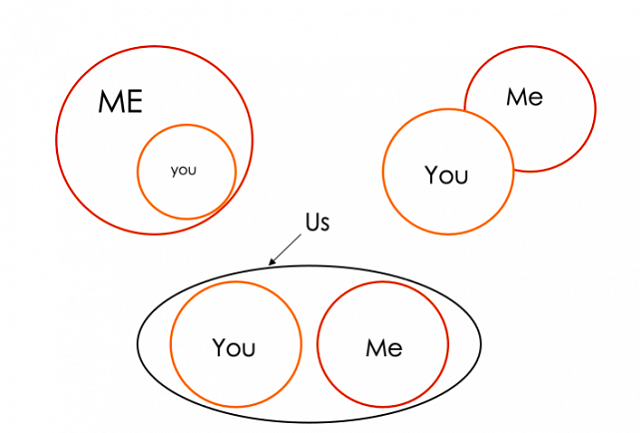
"in a strongly committed relationship, there will be some identity of us, and it will have a boundary."
The author uses a diagram of relationship dynamics:


"In some relationships, there is a painful reality where both the top right and bottom drawings reflect the reality of the relationship, with one partner wanting the former and the other preferring or only capable of the latter. Those are situations where one partner is substantially less committed than the other, and likely a lot less willing to have, develop, or nurture that third identity."
 
"For those who want the 'us' in their life, they will have to look for a relationship with the right balance of me and we, and then invest in protecting it." (emphasis added) This protection is what policy is for, at the societal level.
 

Tuesday, May 4, 2021

There it is.

Tonight I gave my presentation in Ethics and Educational Decision Making, a very cool topic in its own right, and one that is at the core of my philosophical inquiry. 
 
I've spent the last several weeks on this, and the whole of the course knowing that this topic is where I needed to dig to find my dissertation. The readings and conversations each week were excellent and pushed me in just the right directions at just the right time. The syllabus has an elegance that can only be understood by looking back, and I'm glad I took the time to really delve into this for real answers.
 
The magic happened yesterday evening, that moment when all the side notes of analysis and the structural bits of logic and craft came together to create a fertile tendril of its own. I spent five hours letting the flower unfold, and then this morning I trimmed and shaped until it was a bouquet.
 
All sorts of stuff is happening in my so-called real life, and lately it's been a struggle to do even small things. Some days thinking is too much. the last couple weeks I'd begun to worry if it would ever come back.
 
The success of the last 24 hours was restorative, and I was fine until I started making tea ten minutes before the presentation. Not a crisis of confidence in the work, but a deep shaking desire not to be seen. I leaned against the wall, letting the undeniable tears have their way until the kettle boiled. 
 
I washed my face and changed my blouse while the tea steeped. There were four whole minutes left yet, and I moved slowly through each one, tying my hair up, fetching the pages of the presentation, opening the laptop, stirring sugar into the freshly poured tea.
 
The structure of class took over, and I barely noticed the shaking in my core -- reading a strong work is settling for me, kind of the opposite of stage fright. I didn't give any preamble about why this is the line of inquiry that spoke to me, I simply looked at the top line and let the words on the page take me, as they always do. When I got to the last line ten minutes later, I was kind of sad to see them go. I muted my mic.

I looked up at the quiet zoom room, wondering if I'd muted them instead, and then the professor spoke. I don't remember his first statements, and didn't really come back to reality until I was reaching for my pen to take a note on his suggestion for long term considerations of the avenue I had recommended. I had forgotten to bring my notebook and pen. When does that ever happen? I fetched the almost dead marker from my desk, the only writing instrument in the room, and scrawled "educational long term strategy" on the back of the presentation.
 
By the time the next presentation began, I was nearly human again. All of the presentations have been so great, and I feel honored to have had the wisdom of these fellow scholars this term. I felt solid about my work and the presentation. After class I poured the rest of the tea into my mug and talked with a friend, not realizing how keyed up I'd been until the drop came, ten minutes into the conversation, a warm weariness that oozed down through my bones and rooted me to the chair, to the floor, to the ground. I'd be asleep in thirty minutes or less, so I heated up some leftover Golden Noodle Heal All, brushed my teeth, and headed to bed.

I was drifting off when my phone chimed with a text, and I blearily realized that meant it wasn't on the charging stand -- the charging routine goes into do not disturb, possibly my favorite technological feature ever. 
 
The message from my professor made my whole day.


Onward, friends.


Sunday, April 4, 2021

Home again


This morning I woke up in my own bed for the first time in weeks. It's nice to be home. 
 
I was tidying up and settling back in, watering the plants and sorting the post, when I realized that the next policy analysis paper for the Politics of Leadership class is due tomorrow. I had been so focused on the paper for ethics (due Tuesday) and the editing work for the APA Blog that the policy piece had dropped off my radar altogether.
 
I made a fresh pot of tea and walked the dog while I shifted my focus, then decided to jot down a few thoughts before they disappeared, taking stock of how far along I am with the analysis thus far. This paper is the second in a three-part series in which I'm analyzing elements of school budget formulas, looking at the assumptions and systems in the formula factors and how the matrix perpetuates underlying assumptions and systems of inequity.

"Just a few thoughts" turned into two pages, and the structure is on paper. I really like the work that I'm doing this term and more than ever I feel like this is where I belong.

Monday, March 22, 2021

Entrenched Discouragement: Enrollment and Ratings in Funding Formulas


Entrenched Discouragement: 

Critical Policy Analysis of 

Enrollment and Ratings 

in Funding Formulas


H. L. Schmidt


Department of Educational Leadership

EDL 704-201: Politics of Educational Leadership


Dr. Amanda Potterton


March 22, 2021


The coronavirus pandemic of 2020 cast a harsh spotlight on the weak spots across the educational system, from infrastructure concerns to curriculum design and delivery. Underlying all these challenges, schools had to find ways to respond that fit their budgets. Budgets are the silent engine that drive--and often constrain--decisions by individual schools and districts, and allocation of these funds are in turn driven by factors that have an outsized impact: enrollment, property taxes, and student test scores. Designed to help ensure equality and to provide incentives for excellence, Critical Policy Analysis of key factors that drive budgets reveals that they often create inequality and can disincentivize achievement. In their worst application, these measurements actively entrench poor conditions in schools and widen the disparity of opportunity available to students.

Critical Policy Analysis examines the “development, implementation, and outcome” of policies through examination of “contextual and social factors, including systematic and institutional- and individual-level oppression” (Sampson, 2019). Policy analysis positions policies not as things but views them instead as “encoded in complex ways (via struggles, compromises, authoritative public interpretations and reinterpretations) and decoded in complex ways (via actors’ interpretations and meanings in relation to their history, experiences, skills, resources and context).” (Ball, 1993, emphasis added). By identifying critical concerns to evaluate the gap between educational policies’ rhetoric and their practiced reality, we can better see the “social stratification and the broader effect a given policy has on relationships of inequality and privilege” (Diem, Young, Welton, Mansfield, & Lee, 2014 as cited by Sampson, 2019). For the purposes of examining key factors in budget allocation formulas, it is helpful to see how these factors are themselves determined and how they are used as a part of the formula itself. In this paper, I will examine the first of three factors: enrollment specifically attendance as a measure of enrollment.

Proponents of limiting or cutting education budgets often focus on the notion of trimming wasteful spending as a way to reduce costs, a concept that comes from manufacturing and business analysis, not from research in best practices for educational outcomes. Such a framework devalues educational spending and looks at dollars as opposed to outcomes. In times of economic recession and during a period of public outcry against taxation, this market-based rhetoric gained traction in public opinion, resulting in elected officials who reflect contemporary sentiment. Yet qualitative research found that “permanent additional money improved student achievement and high school graduation rates and decreased poverty rates, while sharp spending cuts had the opposite effect.” (Lafortune, Rothstein, Schatzenbach, 2016). 

The emergency created by the pandemic brought the funding crisis for public schools into sharp relief: “Less funding would mean cuts in programs and personnel. And the districts that would be hit the hardest would be those with the poorest and neediest students” (Washington Post, March 15, 2021). Texas, a state that uses average daily attendance to determine district budgets in the state, saw attendance drop over 4% during the pandemic, threatening a tidal wave of cuts to already beleaguered and cash-strapped districts by creating automatic reductions through the attendance-based budget formula. Texas averages total daily attendance. Other states use attendance measures as well, and they can seem confusing and downright capricious: Some states average attendance from Fall and spring terms; Colorado uses the attendance figures from a single day in October.


Funding: Attendance, Enrollment, and the Market

Schools are funded by local (45.6%) and state (46.7%) budgets, allocated to individual schools and districts through funding formulas that can be complicated and complex and that vary from state to state (EducationData.org). This source of funding results in educational budgets becoming matters of the political landscape, skewing along the lines of public opinion more than being treated as a necessary and desirable expense for the public welfare. Two things stand out in market-driven educational budget allocation: attendance-based funding and test-score derived school and teacher ratings. These matrices are intended to provide equality (enrollment) and incentives (ratings). These two measures don't achieve their aims; in fact, they create the opposite effect, entrenching or worsening the problems these policy measures seek to address.

Attendance-based funding impoverishes school budgets. Even the broadest measure of attendance -- total enrollment-- results in diminished funds as students in a district attend private schools, are home-schooled, or drop out. This encourages parents who can afford alternative education to seek extra-public solutions, creating a positive feedback loop of scarcity for those who remain on the public school roster. Using an average of daily attendance is the worst application of this measure, actively penalizing schools where marginalized students often have attendance impediments as a factor of daily life. But even the total enrollment measurement hides the result of reducing funding as students increasingly turn to alternative educational options, whether through private schools (voucher-based, privately funded), or home-school options that reduce overall enrollment without reducing the responsibility of the district to provide quality education, much of which is tied up in fixed costs that do not change during periods of enrollment fluctuation.

Budgets are responsible for providing “equity for students;” “adequate resources to local school districts;” “predictability and stability of education resources over time;” and a finance system that “supports student learning” (NCSL, 2021). Attendance-based funding formulas create actively adverse conditions to all these aims: the variability of attendance can result in quixotic budget reductions while costs stay largely the same. In particular, when resident school-age children attend private or alternative school systems, the local budgets are reduced not only by attendance-based formulas but are often further diminished by tax-offset school choice schema that divert funding from the state coffers under a matrix that “would further magnify the disparities between rich and poor, public and private” (Potterton, Waddington, LaCour, 2021).


Conclusion

Examining the ways in which we measure attendance and performance in schools reveals a reliance on commercialized, commodified, market-driven concepts, most notably from the neoliberal tradition that prefers quantitative data over qualitative research. The outsized valuation of quantitative data reveals prioritization by policy makers of market-based assumptions about the purpose of education, much in line with what Sanchez found (2019). Changing the framework of the formula and analysis of the underlying assumptions implicit in the variables themselves can prioritize best practices and increase “policy knowledge” by being based on qualitative research rather than quantitative measurements, effectively transforming budget formulas “from the ground up.” (Dumas & Anderson, 2014).


References


Ball, S. (1993). What is policy? Text trajectories and toolboxes. The Australian Journal of Education Studies, 13 (2), 10-17. https://doi.org/10.1080/0159630930130203 


Diem, S., Young, M. D., Welton, A. D., Mansfield, K. C., & Lee, P. (2014). The intellectual landscape of critical policy analysis. International Journal of Qualitative Studies in Education, 27 (9), 1068-1090. https://doi.org/10.1080/09518398.2014.916007


Dumas, M.J., Anderson, G. Qualitative research as policy knowledge: framing policy problems and transforming education from the ground up. Education Policy Analysis Archives, 22 (11). https://dx.doi.org/10.14707/epaa.v22n11.2014 


EducationData.org, (2021). U.S. public education spending statistics [2021]: per pupil + total. https://educationdata.org/public-education-spending-statistics 


Lafortune, J., Rothstein, J., Schazenbach, D. W. (2016). School Finance Reform and the Distribution of Student Achievement. Washington Center for Economic Growth. 


Mantel, B. (2018, August 31). Education funding. CQ Researcher, 28, 705-728. www.cqreasearcher.com 


National Conference of State Legislatures (2021). The state role in education finance. https://www.ncsl.org/research/education/state-role-in-education-finance.aspx


Potterton, A., Waddington, R. J., LaCour, S. E. (2021). Tax credit proposal is really a plan or private school vouchers in Kentucky. Courier Journal, Feb 26,2021. https://www.courier-journal.com/story/opinion/2021/02/26/school-vouchers-education-opportunity-account-program-bad-kentucky/6801079002/ 


Sampson, C. (2019). “The state pulled a fast one on us”: A critical policy analysis of state-level policies affecting English Learners from district-level perspectives. Educational Policy, (33)1, 158-180. https://dx.doi.org/10.1177/0895904818807324 


Sanchez, J. (2019). Framing the common core; An analysis of four key policy actors. Teachers College Record, 121 (080306) 1-34.

Wednesday, April 26, 2017

The Civic Connection -- Rasoul

Another great interview. Today I spoke with Sam Rasoul, State Delegate for the 11th district, which includes my fair city of Roanoke. It was a delightful experience, filled with lively and genuine conversation about social justice, political trust, the impact of extreme poverty, increasing options and changing mindsets, and favorite moments about serving.

Keep watching this space for the audio file.

Friday, April 21, 2017

The Civic Connection -- Goodlatte

Today I interviewed Bob Goodlatte, federal representative for Virginia's ninth district. We talked about HR 29, his proposal to terminate the federal tax code of 1986 -- the whole thing -- as a way to force a conversation about what would be better.

I look forward to keeping the conversation with Goodlatte going.


Wednesday, February 1, 2017

Doomsday looms

The closest ever, and just getting closer.
Three minutes to midnight was too many last week.
This week, one can only wonder if that's padded with sixty extra seconds of optimism.
Hint: When Trump advised folks to "Go Nuclear," he wasn't making a reference to Iran. Yet.

Monday, April 25, 2016

Mouth, meet money

If our political leaders claim to be pro-family, they need to put families first by supporting paid family leave.

Sign the petition