Showing posts with label social justice. Show all posts

Thursday, May 1, 2025

The Promise of Protests


for protests to succeed, they must be backed by movements with the ability to promise to withhold—labor, debt payments, rent payments, or consumer support—and to follow through if demands aren’t met. --Olúfẹ́mi O. Táíwò, Time, "Why Protests Should Be Promises," 5.1.2025
This May Day, let us all remember what demands power is making along with concessions. Let us all remember what promises we are expecting, and how we are interacting with the levers of social (in)justice.
 

Friday, February 14, 2025

The Power of Breakfast

This morning I'm thinking about the Black Panther's Free Breakfast Program and the ways in which a single community center focused on meeting basic needs of residents was radical, and the conditions were so unequal that the program became radicalizing.

Volunteers would start setting up and preparing food around 6 am, and served the meal from 7-8:30. Most programs took place in churches, schools, or community centers. A typical breakfast often included some combination of bacon, eggs, grits, hotcakes, toast, sausage, and a glass of juice or milk. Various chapters would also provide transportation for children, from home to the chapter's Free Breakfast site, then to school.


Tuesday, July 18, 2023

Education, Ethnicity, and Equity in Roanoke

I've been doing some research on the demographics of Downtown (highlighted in yellow in the maps below) and how it occupies an intersection of very disparate populations when viewed from the neighborhood level. All in all this paints a very compelling picture of how opportunity disparity is geographically entrenched. 


Monday, July 10, 2023

Save a Life. Open a library.

In his book Heat Wave: A Social Autopsy of Disaster in Chicago, Eric Klinenberg found that having social infrastructure in place was a life-saving mitigation, lowering the risk of death by 80 percent in the heat wave of 1995, the equivalent of having an air conditioner versus not having one. 

In the US, heat kills more Americans than any other weather-related disaster, and the climate crisis has been making these extreme events more deadly. Heat deaths have outpaced hurricane deaths in the country by more than 8-to-1 over the past decade, according to data tracked by the National Weather Service.

The evidence shows that social infrastructure is the most relevant and effective population-wide solution politicians can make. When social infrastructure intersects, such as with public libraries and public transportation, the effects are synergistic.

Public policy can improve lives, and evidence increasingly shows that public policy can save lives. It's time politicians declared a state of emergency and marshalled their policies to create, expand, and maintain as robust a social infrastructure as possible. 

Wednesday, June 21, 2023

The State of Libraries

    Surveillance Capitalism (Zuboff), Digital Colonialism (Kwet), Social Credit (Lee), Datafication (Lycett). My many thoughts on Irresistible Bargains (Pallitto). The titles alone are creepy and insidious, and the articles are enough to make us lose sleep for decades. All of this is a vast landscape straight out of a William Gibson novel; as Lee pointed out, it inspired episodes in the dystopian Black Mirror. My own reading notes along the way are practically a novella.
    But what of libraries? The ALA's core competencies and the library bill of rights both position patron privacy as a foundational tenet of librarianship. I remember when the Patriot Act was introduced in 2001. Under the Patriot Act, the FBI can secretly conduct a physical search or wiretap on American citizens to obtain evidence of crime without proving probable cause, as the Fourth Amendment explicitly requires. One of the (many, many) avenues for discovery under the Patriot Act is a patron’s library use history. Most libraries don’t keep patron checkout records, and after the Patriot Act the ones that did simply toggled the software settings to stop doing that. Designers of library software in the years since the Patriot Act became law started including default settings to not collect or store any circulation or other history, such as requests for items through interlibrary loan. What is most concerning to me about the Patriot Act provisions is the idea that libraries (and other information providers such as bookshops, and possibly even publishers) are dangerous to the state, up to and including suborning terrorists.
While the explicit provisions of Patriot Act itself reflect a deep ignorance of librarians’ structural protections of patron privacy, laws allowing for state surveillance of patron activity and the history of their library activities are in direct conflict with the professional core and patron protections with which we are charged. 
With so much data integration being desired (and, as Pallitto would describe it, as irresistible), how do we provide information services while also protecting patron privacy? Libraries, like every organization, need to make data-driven solutions, which can be done in anonymized ways: Number of books checked out, number of discrete patrons, number of attendees at a program or event, etc. But patrons themselves want more personalized and visible participation: book reading challenges that are integrated through GoodReads or other apps, for instance, are ways to encourage and support community engagement. 
It seems that the core tenets of librarianship are coming into conflict along privacy and big-data fault lines: how are we to engage the community in ways that inspire and support increased library use while also protecting patrons--individually and as a group--from parasitic capitalism or state control programs? 
And, as state surveillance expands, what role does the library have in making documents available to the public that are deemed “too dangerous” for public use?

Friday, November 25, 2022

The common thread.

"Every single vector of the jackpot was weaponized by the same disruptor: human nature. Now, it might have manifested itself as selfishness, or venality, or simple stupidity, but at the bottom, it all amounted to the same trait: our persistent, self-destructive resistance to acting for a collective good."

Wednesday, November 23, 2022

Might have to give Andor a go

"Remember that the frontier of the rebellion is everywhere and even the smallest act of insurrection pushes our lines forward. And then remember this: the Imperial need for control is so desperate because it is so unnatural. Tyranny requires constant effort: it breaks, it leaks."

"Authority is brittle. Oppression is the mask of fear. Remember that."

Monday, November 14, 2022

Here’s the thing

Eric,
Here’s the thing.
We (as in Western culture) have been talking about “the just city” since Plato’s account of Socrates. And when we talk about “the just city,” we talk about education. I mean, we don’t even just give it a polite nod; Socrates spends a fair portion of The Republic discussing the curriculum (because, you know, you can’t go telling stories about the gods, that’s dangerous, and it stirs up the wrong kinds of imagery; everyone’s a critic, but whatever). This country’s revolution was propelled by the understanding that democracy and revolution were impossible without the free spread of ideas; it’s why Ben Franklin convinced his buddies to put their treasured books on democratic ideals at a public house and created the first lending library in the history of ever. That was in 1731, and it took a two generations — 40 years—before the ideas had grown enough in the public conversation that throwing a bunch of tea into a harbor seemed not only rational, but compellingly responsible. We’ve been talking about the Just City for three thousand years, and this country in particular conceives of itself as exceptionally just, from John Winthrop to Eisenhower, our national narrative is one of “A city on a hill” so blessed with “prayse and glory that men shall say. . . , “the Lord make it like that of New England.” A beacon shining against tyranny, a new land “with liberty and justice for all.”

We know what works to achieve good outcomes for students: low student teacher ratios in accessible, adequately funded schools. This, in fact, is what the private schools are selling and which parents buy without hesitation. If we know what works and aren’t doing it, it’s because we don’t want to. I don’t much care why we don’t want to; I’m a utilitarian, so I don’t think why we harm others through our (in)action has much weight. When I decide to have a chocolate bar, I know I’m not doing anyone any favors. I know that each cocoa bean is produced in horrible, inhumane, and at times inhuman conditions. But do I say no? No, I do not, not always. Because I don’t want to. Please do not expect me to simply overlook that the situation in United States educational policy is one of not knowing what works. We know. We just don’t care. Why don’t we have a bold federal program? Why didn’t George H. W. Bush, who decided to undertake securing better outcomes for students, launch a sweeping federal program the likes of which haden’t been seen since the New Deal? Because he didn’t want to. Please do not expect me to think that Bush, the head of the CIA, mentored by the head of the OSS, didn’t know what policies would make a difference or how to enact them. He knew. He didn’t care.

We’re the United States of America.
If we’re not doing something, it’s because we don’t want to.

I think that the way we have progressively kicked the responsibility for meaningful educational policy further down the line since Brown — from states, to municipalities, to neighborhoods, to now local school boards devolving into fights over everything from masks to comic books — shows that the educational landscape is thoroughly Balkanized, divided into increasingly smaller, mutually hostile groups. I think this is a moral failure of political leadership; I think this is a threat to democracy; and I think it is bad for everyone.

It’s a moral failure of political leadership in the most basic utilitarian analysis: to know that the action you undertake will create harm to others is only justified when not taking that action would create a sacrifice of equal or greater marginal utility. Truly, denying myself chocolate isn’t on par with forced child labor; denying myself a glass of wine isn’t comparable with enduring sexual assault. Claudia Card writes in The Atrocity Paradigm that callous disregard for the harm we do to others is the definition of evil. I don’t disagree.

I believe providing a robust educational system is essential to fostering democracy, and that the lack of actively fostering democracy opens the door to courting an authoritarian and totalitarian state. See Dewey, and Socrates, and wow, so so many people.

I believe that a well-educated society is one in which everyone is better off, not just the well educated. I believe that to diminish education in a community of any size or to let the educational institution decay is to actively diminish the scope of human wellbeing in those communities. I know that holding education as the cure for social ills carries with it a quiet trap of seeing individuals as responsible for their own mobility, but with that caveat, I also believe that education remains the single most powerful remedy and inoculation against human misery. It is the path by which communities thrive, not merely individuals. 

Public policy, especially educational policy, has the capacity to enrich lives. 
Therefore it should.

Saturday, June 19, 2021

We-ness, Identity, and the Nation State

My research takes me to some pretty surprising places. I've been thinking about identity a lot lately, in terms of how public policy reveals our sense if who we are as a people, and how resistance to inclusion shows where our commitments are.
 
This morning I ended up at the notion of "we-ness," something psychologists speak of, but that I think has relevance for understanding the current turmoil in recent events, especially when looking at how marginalized members of society have been pushing against the status quo, and how to balance robust inclusion with healthy respect for individuality.
Us, with a future.
From the article:
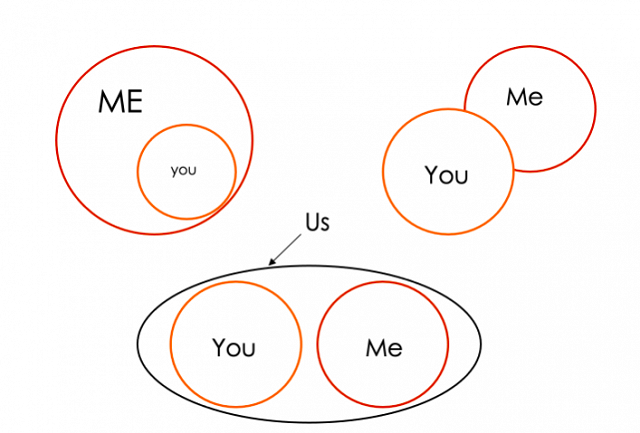
"in a strongly committed relationship, there will be some identity of us, and it will have a boundary."
The author uses a diagram of relationship dynamics:


"In some relationships, there is a painful reality where both the top right and bottom drawings reflect the reality of the relationship, with one partner wanting the former and the other preferring or only capable of the latter. Those are situations where one partner is substantially less committed than the other, and likely a lot less willing to have, develop, or nurture that third identity."
 
"For those who want the 'us' in their life, they will have to look for a relationship with the right balance of me and we, and then invest in protecting it." (emphasis added) This protection is what policy is for, at the societal level.
 

Saturday, December 29, 2018

It All Started with Yarn

One day, about 13 fullmoons ago, I had a rotten afternoon. I was edgy and angsty and emotional.  Inspiration and creativity are my best tools when this happens, and connection with others opens me to possibilities. I looked at Vivian and said, "Want to go to the yarn store?"

And we were off.
We talked with Gina about everything, but mostly of big smooshy futures without limits. We fell in love with yarn, of course, and we each came home with a projects worth of atisan dyed goodness.

Within a week I had two insights:
1) I was going to need more yarn and
2) The Manis Yarns artist village was a too-well kept secret. I was going to need to write about it, and to have a photographer go with me.

By the end of the next full moon I had a lovlel dress designed, for inspired to update my hair cut, and was in need of an agent.

Time passed, as it always does, filling in the books and crannies with due dates and task lists. It was filled with its own inspiration and creativity, new bits of voice to explore and bring forth as well as the mundane details and navigation of the landscape of reality.

Today the yarn is speaking to me again.
This time not of sheath dresses in poorboy knit, but of a piece on empowerment and social justice.

A piece about what empowerment of indigenous people and women really looks like. Decision making etc. Process mapping the whole thing while amplification of the results. A piece about what a community organized around justice entails, how it works, and why it matters.

And, you know, yarn.
Always with the yarn.

Saturday, December 2, 2017

Out and about

Harvey and I met up with some Friends to attend the NAACP luncheon on peace and social justice. It was an inspiring and uplifting gathering, and Jeff May's message was motivating. As a lovely bit of synchronicity, I was seated next to Idella Glenn of Hollins. We had a lovely chat during the event.

After the Friends dispersed, we visited the local yarn store and I got advice on where to get test knitters and technical editing for the dress pattern (ravelry, of course) and talked yarn weights and processes and more fiber goodness.

Then we made our way downtown, where we got some sipping chocolate, talked about what we had learned, and relaxed.

We grabbed a pizza from Buddy Marconi's across the street and considered ourselves off the hook for cooking for the day.  They sell a 28" pizza and give away $500 if you eat it all in an hour. I didn't make it all the way through my single slice of pepperoni; it's huge.

In the village, we dropped in on Erica at the toy store to give her an Advent gift and to enjoy caroling on the porch. I love that place.

Before going home, we caught up with Linda at Too Many Books. I have been eyeing a stitches book that she has and finally decided to buy it for the home library.

We played Quiddler while we ate pizza and then picked up some oranges and sundries at the co-op before watching Mr. Robot.

Another fantastic Saturday in the Village.

Sipping chocolate at the chocolate store

Caroling on the toy store porch

Planning my next project

Thursday, July 13, 2017

Even if

So even if someone is beating you, knocking you down, even if you’re down on the ground trying to protect your head, you try to maintain eye contact. Let the person who’s trying to hurt you see your humanity.
----John Lewis

Tuesday, May 16, 2017

Edwards Interview

I had a lovely time talking with Senator John Edwards this afternoon. We talked about transportation, education, medicaid expansion, and the importance of local politics.

Watch this space for the audio.


Tuesday, May 2, 2017

In the Shadow of the Hill

My first thoughts as I watched the film were that favela life was culturally rich even if it was possession- and cash-poor before the drug lords came in. As we watch the scenes unfold, it is this richness of connection and community that holds the narrative and refuses to give up, showing a resilience in the face of oppression, violence and vilification that cannot be silenced and that, eventually, overcomes injustice.

Rio de Janeiro didn’t care about how the traffickers’ hostile occupation of the favelas affected the disenfranchised residents in the impoverished favelas, despite having a thriving community. Rocinha was especially disrupted by the traffickers, but equally especially ignored by the politicians. The ‘favela problem’ wasn’t seen by the politicians until the city was awarded the honor of hosting the 2014 Olympics, and then the government saw the favelas, but saw them as a problem to be eradicated, by force if necessary. The favelas were seen as troubling not because of the disenfranchisement, racism or unrelenting poverty and poor housing conditions, but because of the need to assure the Olympic Committee and the global tourists who would soon be visiting that the city of Rio was safe and clean, two things the city government held that the favelas distinctly were not. The trafficker-controlled favelas, Rocinha the largest amongst them, stood as a direct counterpoint to the image and narrative that Brazil and Rio were showing the world.

I find it interesting that the government policy to address this undesirable element to be that of “pacification,” the overrunning of the favelas by force with guns and armor. This annexation of the favelas through martial law was an extreme response, one that reflects the government’s comfort with the use of threat and intimidation through a police state in the middle of the city. The residents are treated little better than animals. Early in the film, we see a man in a suit walking in Rocinha, heavily-armed and armor-clad officers at every turn warning him of the folly. He saunters casually through the lovely sun-drenched day, pointing out bullet holes in the murals, his nonchalance its own protest against the fear that the officers are peddling.

The rebellion of Rocinha is brutal and inspiring in equal measure. The injustices rained down upon the slum residents reflect their second class status, showing the Brazilian government’s priority of joining the global cities ranks over the safety and community of its local Rio citizens, even if they be poor or black. Power corrupts; Money corrupts; guns corrupt; the combination in Rocinha leads to an explosion of the poor against the government who would eradicate them altogether.

The protests began around a single missing man, but quickly become the voice of the power of community even in communities without power. Through creativity and organization, Rocinha citizens stand up, push back, and claim their right to live, even in a favela. They refuse to be silent despite threats of violence and vilification by the press. They engage a wider audience by taking their outrage to the internet, adding the government’s attempts to silence them to their listed complaints. Change comes, eventually, in a real and meaningful way. Michelle Lacerda says that “Twenty years ago, a black favela resident would have deserved their death in the eyes of the public, but not today.”

It is the eyes of the public, the very global perspective that Rio and by extension Brazil want to claim, that brings the justice to the community. The world stage backed the protesters, making it more than an outcry and transforming the organized resistance into real empowerment. Through exposure, their plight became real and the residents became seen. While we are all aghast at the government and its abuses, we rejoice with Lacerda when she says, “There is justice in this country. It’s slow, complicated and sometimes corrupt. But it exists.”