Showing posts with label libraries. Show all posts

Saturday, March 15, 2025

Beware the Ides of March

So much is happening right now.
More chaos and confusion, and I felt a bit defeated with the Senate vote yesterday, and then hours later the Executive Order to dismantle seven more agencies, including the Institute of Museum and Library Services. It’s not even a federal agency, but an independent one, and I am so tired of the abject absence of the rule of law and also of basic common sense about government. Common decency has been lacking for some time, but the sense of dim-wittedness is exhausting. 

And then today we had actual military strikes, as though domestic tornadoes, wildfires, and severe storms weren’t enough. 

Beware the Ides of March, dear Reader. 

Saturday, September 14, 2024

The threat of education

Education has always provided the tools to identify, disrupt, and even to dismantle the market forces of capitalism and commodification. It does so by making the "invisible" hand of the market visible, and then by providing a forum (apparatus) in which individuals can discuss and examine (Humanities) the effect of the now-visible market.

The threat of education to market interests has grown in direct relationship to the prosperity of the country. That is, as economic scarcity became less real at the collective level, the need to reify the struggle that fuels market competition grew; if individuals reject the capitalist engine that they propel, the ship will stop moving. [But it likely won't sink]

Brown 1954 presented an especially difficult decision for post-war market culture: it was rooted in equality of educational resources for all, at a time when economic prosperity was so robust that the lie of scarcity was almost a neon sign. In the two decades since the Great Depression, the United States had turned a cultural corner as well as an economic one, and equality of all was clearly about to catch up with equality of prosperity.

In many ways, the students who walked out of an underfunded school in Virginia in protest did so in a great acknowledgement that they possessed and were being denied the apparatus of prosperity. Barbara Johns and the students who followed her led to Brown, and set off the sensibility of equality that would lead to Rosa Parks, Medgar Evers, Martin Luther King, and the formation of the NAACP.

Public institutions and public goods are central to the measure of equality in our culture and in our struggle to complete the promise of democracy. Schools and libraries, in particular, have been essential in measuring the distance we yet have to go, and in nurturing the sensibility required for completing the assignment laid down in the declaration of independence.

[Tougaloo Nine]

Friday, August 9, 2024

The magic of libraries

"The world is very stressful. The library makes me feel at peace and curious and in control of my time. I love that it’s a public space where I can also have a private moment. We can be alone together. To me, that is sacred.” —Andy Crocker

Saturday, September 2, 2023

What's it like to be a librarian

Lots of people assume that being a librarian is getting to do lots of research, reading, and writing. More often it's filled with mundane things like shelving and hunting down books for patrons. 

And then there's this guy:


Wednesday, August 23, 2023

A librarian happened to be in the audience

“I really didn't realize the librarians were, you know, such a dangerous group.
They are subversive. You think they're just sitting there at the desk, all quiet and everything. They're like plotting the revolution, man. I wouldn't mess with them. You know, they've had their budgets cut. They're paid nothing. Books are falling apart. The libraries are just like the ass end of everything, right?”

Michael Moore knows a thing or two about the power of one librarian with a listserv.

Michael Moore duscussed Harper-Collins' suggestion that he tone his anti-Bush rhetoric down in his upcoming book or they would scrap the project.


"She was on a librarian listserv [an early Web discussion group], and apparently she wrote a letter to the other librarians, telling them that Harper-Collins wouldn't publish the book, and here's why," Moore said.

"A few days later I got a call from my editor at Harper-Collins, screaming: 'What did you tell the librarians?' I said, 'I didn't tell the librarians anything!' 'Well they're out there picketing us. In Manhattan!'" the filmmaker said. "Essentially the publisher was afraid, because the message would be to other writers, if you sign with Harper-Collins, you're signing with a censor. You might not want to do that.

"Huge egg on their face," Moore said. "But the most important thing it did was to remind me that a single person can effect change. We should have a Rosa Parks holiday to tell people, don't just sit there, do something. We need to dispel the great lie that you can't do anything about things."

Tuesday, July 18, 2023

Education, Ethnicity, and Equity in Roanoke

I've been doing some research on the demographics of Downtown (highlighted in yellow in the maps below) and how it occupies an intersection of very disparate populations when viewed from the neighborhood level. All in all this paints a very compelling picture of how opportunity disparity is geographically entrenched. 


Monday, July 17, 2023

A Call to Action

The ALA Code of Ethics Item 9 is inspiring and also reads like a call to action: We affirm the inherent dignity and rights of every person. We work to recognize and dismantle systemic and individual biases; to confront inequity and oppression; to enhance diversity and inclusion; and to advance racial and social justice in our libraries, communities, profession, and associations through awareness, advocacy, education, collaboration, services, and allocation of resources and spaces. Though this is last on the list, it seems to underlie everything above, creating a foundation for the Big Why of what libraries do and how they do it, regardless of what specialization or sector the library occupies. Whenever in doubt, this provision guides us to the librarianship standard. In much the same way that basic labor laws are posted at the workplace and that Patient’s Rights are posted in medical clinics, I’d like to see the ALA Code of EthicsLinks to an external site.Links to an external site., ALA Core ValuesLinks to an external site.Links to an external site., and the ALA Library Bill of RightsLinks to an external site.Links to an external site. posted in every library. The Attendant Freedom to Read should be posted as well, especially in the children’s area. Provision 1 of the Freedom to Read StatementLinks to an external site.Links to an external site. states “It is in the public interest for publishers and librarians to make available the widest diversity of views and expressions, including those that are unorthodox, unpopular, or considered dangerous by the majority.”  This is paramount for patrons to understand that they have the right to expect the library to act as a portal into the unknown, even (and possibly especially) when the unknown leads to topics and content deemed unorthodox, unpopular, or dangerous by the majority. Beyond just presenting ideas and materials, this statement makes clear that the library is -- by design and as a mission -- a safe space for oddities. Many of those who found themselves in libraries were able to do so because they themselves were deemed unorthodox, unpopular, or dangerous by the majority.  
In her 2018 article “Ethics, values, and intellectual freedom in school libraries,” Dr. Oltmann found that school librarians seem to have the least support for ALA ethic of resisting censorship and ALA core of democracy, and that these two elements are difficult to see as relevant to their regular work life in school libraries. I find it very interesting that school librarians are likely to self-censor on diversity and inclusion lines with regards to materials, and that they often use age-appropriate factors in limiting materials in the school library, while also skewing towards reflecting existing community diversity. This seems like a natural human inclination, but one that is problematic in terms of the ALA professional standards. 

Wednesday, July 12, 2023

Book Bans are about control

"Of course it's a worry when anybody takes it upon themselves to dictate what people should or should not read. The power of organised religion is very strong in the US, and getting stronger because of the internet." -- Philip Pullman, 2009

In 2008, Pullman's books were taken from school libraries and public library shelves."One challenge at a school in Winchester, Kentucky was made on the grounds that the book's main character drinks wine and eats poppy with her meals. Another school in Oshkosh, Wisconsin pulled the trilogy because of its "anti-Christian message".

Back in 2009, when Pullman's trilogy became the second-most banned book of the year, ALA's Deborah Caldwell-Stone issued words that two decades later would become a mantra: "We believe parents do have the right to dictate their children's reading, but that right exists for their children alone and should not be extended to others."


All this means that those of us who read these books -- usually purchased from bookstores -- were wholly unaware that they were reading a censored version.

Saturday, June 24, 2023

Information Ecology

An information ecology is “a system of people, practices, values, and technologies in a particular local environment.” (Nardi & O’Day, 1999) I’d like to highlight two words from this, the first being system and the second being local. For the purposes of my research, the local-ness of the system is key, and I think it’s really important not to lose sight of how each library differs because of its governing locality. Even if two libraries were identical in all other ways, being on opposite sides of town would change their information ecology just by changing the populations they serve. In reality, no two libraries are identical, and existing “on the other side of town” can create differences in the ecology that have dramatic differences in the services that are provided. For instance, if all libraries in a city or consortium are funded equally from the budget, but one has three times the square footage of the other, the utility bills alone of the larger library could leave the programs, services, and staffing budget decimated. If the libraries are funded by square footage, smaller libraries who serve just as many patrons can find themselves spread thin when trying to address the community needs. If libraries are funded based on property tax contributions, libraries in poorer sections of town can have dramatically reduced budgets compared to wealthy neighborhoods, an inverse of the typical use patterns in libraries and one which re-presents wealth inequality as inequalities of service. The previous examples are all about budgets, but there are other municipal factors as well: A gorgeous new library with all the latest technology and programming services and an eye-popping collection of materials for all ages isn’t of much use if it’s stuck out on the edge of town without access from public transportation. This is exactly the situation of the crown jewel library in my town, a gorgeous building with a phenomenal collection -- it even has a coffee bar and a 3D printer. It’s amazing, and one of the most inviting spaces in the whole city. One of the reasons planners were able to spend all this money on the building and holdings was that the land that they found to build on was on the far edge of town, not even in the city limits; land in the city is expensive, when it can be found at all; the price goes down and availability goes up as you move away from the town center, so several acres over the county line seemed worth every penny. The County library is a 20 minute drive from the center of downtown; to take a Lyft or Uber would be upwards of $20 one way. 
And if you ask librarians to name the single greatest constraining factor for their particular branch library, school library, law library, or practically any other information services organization, they'll often say space. Information materials take space on shelves; computer labs and meeting rooms and coffee bars and viewing rooms take space for the patrons. And it’s all necessary for a library to work. So when the plans were rolled out for a large building with beautiful windows and expansive grounds and plenty of space, no one said “but it’s not on the bus line.” But, as a consequence, the availability of the best library for 50 miles in any direction is that it is unavailable for most of the library patrons in the city; it’s remote enough that it might as well be on the moon for those who would be most served. 
    One of the things I find interesting is how this simple difference has skewed the informational landscape in the city. The County library doesn’t only have a 3D printer and movie theater viewing room that the city libraries couldn’t dream of having; it also has passport services available, a notary, hosts a mobile DMV clinic every week, and serves as a voting location during elections. None of these essential civic functions that the County library provides are restricted by space, but somehow the City libraries don’t offer these services, making the libraries in the City far less civic and diminishing the overall opportunities for civic engagement for city-neighborhood patrons. This small thing -- being available on the bus line -- has an enormous impact on the information ecology for the City and its residents.

Wednesday, June 21, 2023

The State of Libraries

    Surveillance Capitalism (Zuboff), Digital Colonialism (Kwet), Social Credit (Lee), Datafication (Lycett). My many thoughts on Irresistible Bargains (Pallitto). The titles alone are creepy and insidious, and the articles are enough to make us lose sleep for decades. All of this is a vast landscape straight out of a William Gibson novel; as Lee pointed out, it inspired episodes in the dystopian Black Mirror. My own reading notes along the way are practically a novella.
    But what of libraries? The ALA's core competencies and the library bill of rights both position patron privacy as a foundational tenet of librarianship. I remember when the Patriot Act was introduced in 2001. Under the Patriot Act, the FBI can secretly conduct a physical search or wiretap on American citizens to obtain evidence of crime without proving probable cause, as the Fourth Amendment explicitly requires. One of the (many, many) avenues for discovery under the Patriot Act is a patron’s library use history. Most libraries don’t keep patron checkout records, and after the Patriot Act the ones that did simply toggled the software settings to stop doing that. Designers of library software in the years since the Patriot Act became law started including default settings to not collect or store any circulation or other history, such as requests for items through interlibrary loan. What is most concerning to me about the Patriot Act provisions is the idea that libraries (and other information providers such as bookshops, and possibly even publishers) are dangerous to the state, up to and including suborning terrorists.
While the explicit provisions of Patriot Act itself reflect a deep ignorance of librarians’ structural protections of patron privacy, laws allowing for state surveillance of patron activity and the history of their library activities are in direct conflict with the professional core and patron protections with which we are charged. 
With so much data integration being desired (and, as Pallitto would describe it, as irresistible), how do we provide information services while also protecting patron privacy? Libraries, like every organization, need to make data-driven solutions, which can be done in anonymized ways: Number of books checked out, number of discrete patrons, number of attendees at a program or event, etc. But patrons themselves want more personalized and visible participation: book reading challenges that are integrated through GoodReads or other apps, for instance, are ways to encourage and support community engagement. 
It seems that the core tenets of librarianship are coming into conflict along privacy and big-data fault lines: how are we to engage the community in ways that inspire and support increased library use while also protecting patrons--individually and as a group--from parasitic capitalism or state control programs? 
And, as state surveillance expands, what role does the library have in making documents available to the public that are deemed “too dangerous” for public use?

Monday, June 19, 2023

The Internet Changed Everything

Lupač opens his 2018 article “BeyondThe Digital Divide: Contextualizing the Information Society” with “the internet has changed everything.” Lupač isn’t wrong. In five words, he has described the quake at the foundation of society, one that shook everything loose and positioned information -- and our access to it -- into the very center of how we live our daily lives. In the five years since Lupač wrote this understatement of the century, the everyday reliance on the internet has become more entrenched and entwined than ever. For Example: Before we catch the bus to work or school, we check the weather--on our phones, or increasingly on our watches-- to see if we need an umbrella or a jacket; we expect a digital assistant or text alert to let us know if the bus is running late or if there have been changes to routes or fares; on the bus, we can pay with tokens or cards or, increasingly, tap our phones or watches for the bus fare; once at work or school, we log in to various devices to participate, either by downloading information that we will work with for the tasks at hand, or by uploading content, and frequently our work is more collaborative that ever, collaborations that take place in the digital sphere, separate from the physical space we might occupy. 
The more important and central an item is, the more likely it is to be necessarily located in the digital landscape: banking, medical, groceries, transportation. These fundamental aspects of living are inherently digital, many of them not available offline or even by telephone. 
I have a friend who runs an intentional community in the mountains. Founded in 1974, there was no electricity or other civic infrastructure such as public water. In the last decade, the community set up a small battery of solar panels specifically to run a modem and router so that there could be a small but meaningful amount of internet available. When I asked why this mattered enough to be part of the community infrastructure, he told me it was no less important to human thriving in the community than the tools collected for the large community garden: it was a necessary tool to support daily survival. 
Bridging the digital divide is essential, and libraries have always held this to be a core for their vision as well as their mission: providing information itself, but also providing access to it is a fundamental tenet of libraries and librarianship. Why? “A better understanding of the mechanisms behind the societal proliferation of ICT can serve to provide clearer insight into deeper underlying issues, such as how human societies shape their material infrastructures and how these infrastructures are interconnected with such inherently sociological issues as social inequality, social change and social structures.” (Lupač 2018, p3). As all of society has transformed from a knowledge society to an information one, the library has likewise transformed from being an information provider to a social equalizer, such as it has the capacity to do so. 
Along the way, libraries, like all social institutions, are caught in the web of how we present the tools of this new society-- are we making choices that re-present the inequalities, or possibly even entrench the inequalities we hope to eradicate? What options exist for information providers such as the library to level the playing field? Budget constraints are conversations librarians and information architects are frequently not privy to and have no voice in, yet these are the very discussions that are essential in overcoming the digital divide and presenting information as a solution and not as a weapon of inequality and disenfranchisement, no matter how innocent or well-meaning the designs might be.
As my investigation of information society issues enters its third decade, I’m more aware than ever of how physical community remains important to the landscape of human thriving. I continue to see the real-time, real-life benefits and enrichment of in-person community events and sharing. Frequently during our deployment of informational, digital tools, the landscape of the in-person reality is getting deprioritized, sidelined, and at times lost. I think of the digital solutions that were employed during the pandemic, as schools and offices scrambled to replicate normalcy and enable the work of daily life to continue during a social shutdown. The digital divide was on full display especially in education, as students who had the economic resources for high-speed internet and quality laptops were able to participate nearly fully, while less advantaged students often fell out of the curriculum altogether. 
I think it’s essential that we as information professionals keep a balance between providing information tools and using community placement and partnership to enhance and enrich in-person programming. Being an information society means we have a responsibility to address the societal needs of our communities and patrons through information, not just to deliver data. It’s also important to discern how the delivery of data connectivity carries and creates its own inherent assumptions of access and digital privilege.

Friday, April 14, 2023

The new face of anti-literacy is just as ugly as it ever was

Southern slave states enacted anti-literacy laws between 1740 and 1834, prohibiting anyone from teaching enslaved and free people of color to read or write. While school was difficult to attain in the North, it wasn’t illegal. Breaking anti literacy laws in the South was dangerous for students and teachers alike: In most southern states, anyone caught teaching a slave to read would be fined, imprisoned, or whipped. The slaves themselves often suffered severe punishment for the crime of literacy, from savage beatings to the amputation of fingers and toes.


Today’s efforts to criminalize librarians for providing “dangerous” material is a modern revision of anti-literacy laws, and its effect is no less chilling.

Missouri
Indiana and Iowa
North Dakota
Idaho
Michigan
Tennessee
Georgia
Montana: "There needs to be some book burning."

The current hostility and accusations are having a chilling effect on librarians.

A Louisiana librarian says she no longer feels safe in public after the state attorney general and conservative groups accused local librarians of trying to “groom” and “sexualize” kids by offering books with LGBTQ+ themes.

“I am scared to go places in public,” Amanda Jones, a middle school librarian in Denham Springs, told PBS News Hour. “I fear for my safety, I purchased a taser. I purchased pepper spray. I got additional security cameras around my home.”


Monday, January 30, 2023

Number 5 will not surprise you

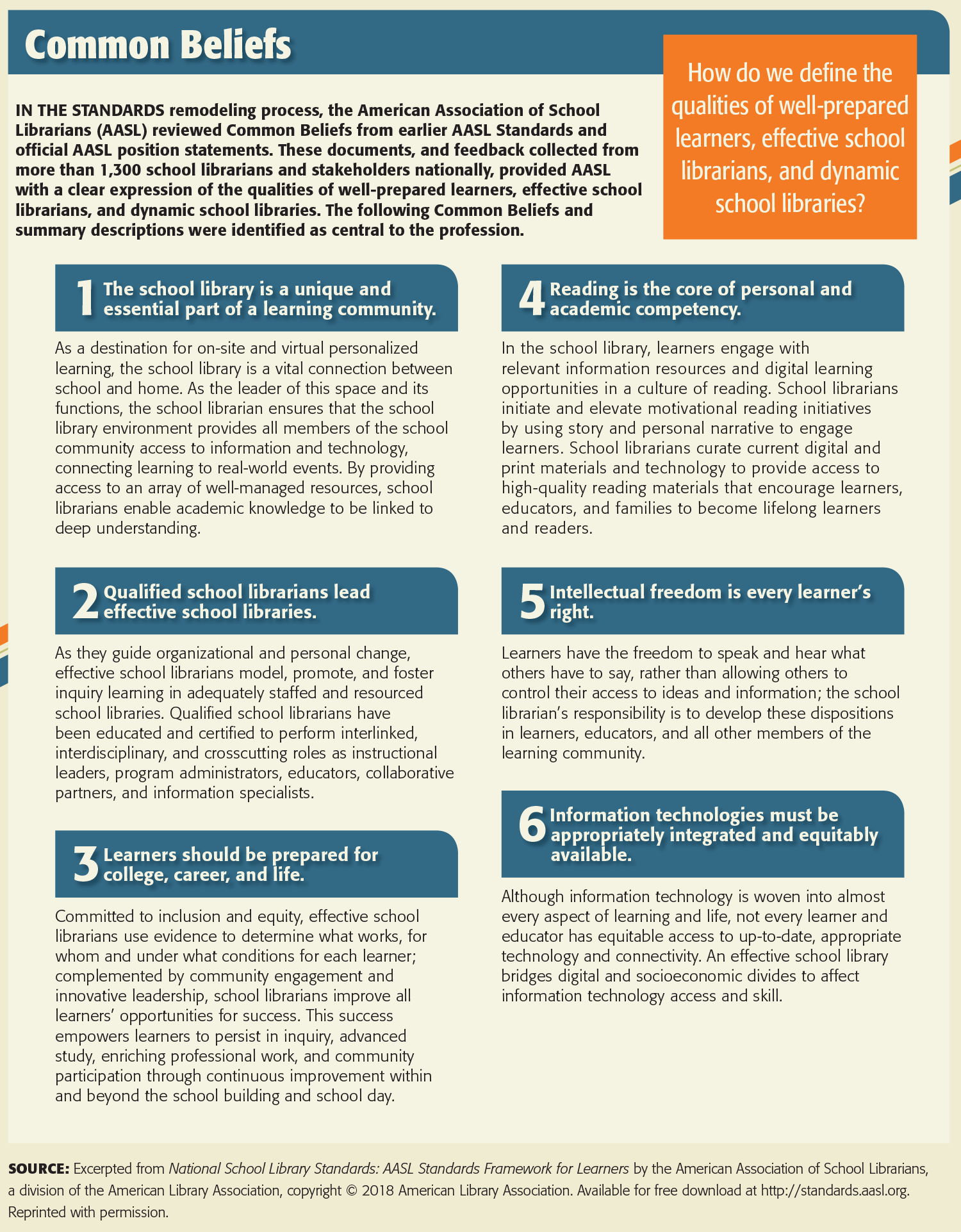
American Association of School Libraries updated Common Beliefs (2018):
https://standards.aasl.org/beliefs/ 
https://kappanonline.org/wp-content/uploads/2018/03/15pdk_99_7_tbl2.png
“5. Intellectual freedom is every learner’s right.
Learners have the freedom to speak and hear what others have to say, rather than allowing others to control their access to ideas and information; the school librarian’s responsibility is to develop these dispositions in learners, educators, and all other members of the learn­ing community.”


Monday, November 14, 2022

Here’s the thing

Eric,
Here’s the thing.
We (as in Western culture) have been talking about “the just city” since Plato’s account of Socrates. And when we talk about “the just city,” we talk about education. I mean, we don’t even just give it a polite nod; Socrates spends a fair portion of The Republic discussing the curriculum (because, you know, you can’t go telling stories about the gods, that’s dangerous, and it stirs up the wrong kinds of imagery; everyone’s a critic, but whatever). This country’s revolution was propelled by the understanding that democracy and revolution were impossible without the free spread of ideas; it’s why Ben Franklin convinced his buddies to put their treasured books on democratic ideals at a public house and created the first lending library in the history of ever. That was in 1731, and it took a two generations — 40 years—before the ideas had grown enough in the public conversation that throwing a bunch of tea into a harbor seemed not only rational, but compellingly responsible. We’ve been talking about the Just City for three thousand years, and this country in particular conceives of itself as exceptionally just, from John Winthrop to Eisenhower, our national narrative is one of “A city on a hill” so blessed with “prayse and glory that men shall say. . . , “the Lord make it like that of New England.” A beacon shining against tyranny, a new land “with liberty and justice for all.”

We know what works to achieve good outcomes for students: low student teacher ratios in accessible, adequately funded schools. This, in fact, is what the private schools are selling and which parents buy without hesitation. If we know what works and aren’t doing it, it’s because we don’t want to. I don’t much care why we don’t want to; I’m a utilitarian, so I don’t think why we harm others through our (in)action has much weight. When I decide to have a chocolate bar, I know I’m not doing anyone any favors. I know that each cocoa bean is produced in horrible, inhumane, and at times inhuman conditions. But do I say no? No, I do not, not always. Because I don’t want to. Please do not expect me to simply overlook that the situation in United States educational policy is one of not knowing what works. We know. We just don’t care. Why don’t we have a bold federal program? Why didn’t George H. W. Bush, who decided to undertake securing better outcomes for students, launch a sweeping federal program the likes of which haden’t been seen since the New Deal? Because he didn’t want to. Please do not expect me to think that Bush, the head of the CIA, mentored by the head of the OSS, didn’t know what policies would make a difference or how to enact them. He knew. He didn’t care.

We’re the United States of America.
If we’re not doing something, it’s because we don’t want to.

I think that the way we have progressively kicked the responsibility for meaningful educational policy further down the line since Brown — from states, to municipalities, to neighborhoods, to now local school boards devolving into fights over everything from masks to comic books — shows that the educational landscape is thoroughly Balkanized, divided into increasingly smaller, mutually hostile groups. I think this is a moral failure of political leadership; I think this is a threat to democracy; and I think it is bad for everyone.

It’s a moral failure of political leadership in the most basic utilitarian analysis: to know that the action you undertake will create harm to others is only justified when not taking that action would create a sacrifice of equal or greater marginal utility. Truly, denying myself chocolate isn’t on par with forced child labor; denying myself a glass of wine isn’t comparable with enduring sexual assault. Claudia Card writes in The Atrocity Paradigm that callous disregard for the harm we do to others is the definition of evil. I don’t disagree.

I believe providing a robust educational system is essential to fostering democracy, and that the lack of actively fostering democracy opens the door to courting an authoritarian and totalitarian state. See Dewey, and Socrates, and wow, so so many people.

I believe that a well-educated society is one in which everyone is better off, not just the well educated. I believe that to diminish education in a community of any size or to let the educational institution decay is to actively diminish the scope of human wellbeing in those communities. I know that holding education as the cure for social ills carries with it a quiet trap of seeing individuals as responsible for their own mobility, but with that caveat, I also believe that education remains the single most powerful remedy and inoculation against human misery. It is the path by which communities thrive, not merely individuals. 

Public policy, especially educational policy, has the capacity to enrich lives. 
Therefore it should.

Tuesday, January 25, 2022

Comic Relief

My first celebrity crush, when I was four, was on Alfred, the butler in the Batman tv show and comics. Bruce Wayne always struck me as a bit of a too-tortured soul. I felt sympathy for him, and wanted to be his friend, but I never thought of him as desirable. His superpowers are money (which is only interesting when you don’t have it) and finding the right people for the job like Lucius Fox, who designed and built all the gear on the famous utility belt and also built the batmobile (god, how I wanted a batmobile and a cave to go with it), but Alfred knew everything. Bruce would be sitting in front of his computer, head in hand, lamenting the inscrutability of the puzzle of the moment while Commissioner Gordon was ringing the Batphone off the hook and Gotham lay in peril. Up would waltz Alfred, a towel draped over his suit-clad arm, and say “But young Master Bruce, wouldn’t you just do thus-and-such?” and Bruce would stare in amazement as the pieces fell into place and exclaim his thanks. Alfred, ever unflappable, would reply, “My pleasure. Vichyssoise?” proffering a china bowl and silver spoon. Elegant, collected, and analytic. And he made soup. What’s not to love?

My mom didn’t approve of me reading comic books, so I had to sneak them home from the library. She was afraid that reading them — or reading science fiction or watching horror movies or playing sports of any kind — would make me a lesbian. I begged for comics anyway, not knowing at seven years old what a lesbian was but promising cross-my-heart-and-hope-to-die that I would never ever be one, and she relented, allowing me to buy Wonder Woman (but only Wonder Woman, because she’s a girl) when we passed the comics rack at the grocery store. She had never so much as flipped through the 70s rendition of the amazon of justice, or she would have nixed Wonder Woman in a hot minute: pages filled with colorized pen drawings of scantily clad amazons engaged in vigorous athletics on Paradise Island or of jack-booted Nazis who routinely bound our heroine in ropes and chains would have realized the worst of her fantasies.

I found comic book collections—and all the other things I wasn’t supposed to have—in the library, from A Wrinkle in Time to Alfred Hitchcock’s collections of short stories featuring the horror of daily life, or the movie The Omen on VHS (I slept with the light on for a week). When I was in high school, I met friends in the school library to play D&D for a year before the librarian found out what we were doing and kicked us out, saying we couldn’t meet for satanic purposes. “But I’m not a lesbian!” I wanted to tell her, even though I knew it wouldn’t help.

Saturday, March 13, 2021

SAAP 2021

I miss having conferences in person. There's something special about leaving your life behind and gathering in a NotHere space with like-minded companions, drinking tea or coffee, wandering around having pickup conversations you couldn't imagine, letting someone else be in charge of the mundane details while Big Ideas fill the air.

Even so, I'm glad to be part of the conversation that's happening this weekend at SAAP. My panel presentation tomorrow is on the role of the public library in democracy (of course), and I really am looking forward to it. The ramp up to present has a rhythm to it that got established in the BeforeTimes and holds me now: go over the details and notecards the evening before; texting last-minute updates and edits; a long bath; tea and woolgathering and an early bedtime, though I'm rarely able to sleep until after midnight. Then in the morning, french toast and orange juice and coffee from room service while I go over the note cards One Very Last Time before putting on Conference Clothes and packing up the briefcase.

Tomorrow there's no briefcase required, since I'll be zooming from my living room; I have cinnamon rolls at the ready because I'm at home and not in a hotel; the notes and one-sheets and program schedule are already on the footlocker that I use as a coffee table.

I would love to have a few of you with me tonight, or at breakfast in the morning, standing around with our plastic-sleeved name tags swaying from logo-emblazoned lanyards as we mill about in front of the tables laden with discarded cups, the light glinting just so off the coffee service as we wonder which room we are supposed to be in and how far it is from the bathroom. (We're in Room A.)

Conferences are about sharing space with people sharing ideas. It's a convivial event that is magical, and I miss it.

Tuesday, March 9, 2021

Libraries are dangerous arsenals of the free conscious

The first people a dictator puts in jail after a coup are the writers, the teachers, the librarians - because these people are dangerous. They have enough vocabulary to recognize injustice and to speak out loudly about it. Let us have the courage to go on being dangerous people." - Madeleine L'Engle 


Saturday, November 21, 2020

Writing Life

I've been spending a lot of time writing, and the result is getting to do even more writing. This week I get to draft a chapter or so of my book on Libraries -- it's advanced to the final round for possible publication.

I presented the work this time last year, and I'm very excited, Friends.

Between this and the great stuff coming from the memoir work, I'm starting to feel like an actual writer.