Showing posts with label relationships. Show all posts

Saturday, June 19, 2021

We-ness, Identity, and the Nation State

My research takes me to some pretty surprising places. I've been thinking about identity a lot lately, in terms of how public policy reveals our sense if who we are as a people, and how resistance to inclusion shows where our commitments are.
 
This morning I ended up at the notion of "we-ness," something psychologists speak of, but that I think has relevance for understanding the current turmoil in recent events, especially when looking at how marginalized members of society have been pushing against the status quo, and how to balance robust inclusion with healthy respect for individuality.
Us, with a future.
From the article:
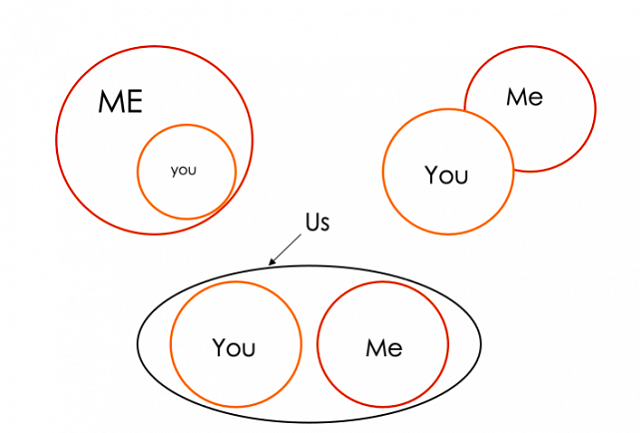
"in a strongly committed relationship, there will be some identity of us, and it will have a boundary."
The author uses a diagram of relationship dynamics:


"In some relationships, there is a painful reality where both the top right and bottom drawings reflect the reality of the relationship, with one partner wanting the former and the other preferring or only capable of the latter. Those are situations where one partner is substantially less committed than the other, and likely a lot less willing to have, develop, or nurture that third identity."
 
"For those who want the 'us' in their life, they will have to look for a relationship with the right balance of me and we, and then invest in protecting it." (emphasis added) This protection is what policy is for, at the societal level.
 

Saturday, April 24, 2021

Response: Coontz, a Marriage


“By all means marry. If you get a good wife, you'll be happy. 

If you get a bad one, you'll become a philosopher.”

---Socrates


In her expansive undertaking to investigate the institution and transformation of marriage in the modern era, Stephanie Coontz takes us on quite a journey through the past, looking at various social changes and pressures in which marriage has existed and through which marriage has changed. She undertook the work to debunk the notion that there was a stable notion of marriage that has persisted throughout history, to address the notion “that there had been a Golden Age of Marriage in the past.” She was surprised to find that modern marriage is, in fact, unique, that “the relations between men and women have changed more in the last thirty yeard than they did in the previous 3000,” “the culmination of a new marriage system that had been evolving for 150 years.”

She’s right to identify the role of marriage as an economic and political institution, one with power to grant an individual a defined role in society. As the economic and political systems changed in the West, marriage had to adapt as well. For mypart, I think she misses a huge piece by not understanding marriage’s role in the feudal system: in the feudal system, political and economic power came through land ownership, and the post-Reformation Enlightenment revolution combined with the burgeoning urbanization to create a working class separate and distinct from the feudal structure of landlord and peasant-tenant. The creation of a cash-based transactional economy was itself revolutionary, and all systems of Western society were forced to shift. Marriage served to provide a structure by which legitimate heirs were identified for the inheritance of the power of land ownership, a power conveyed through primogeniture; much of the stricutures around sexual purity came from the need to verify paternity for the conveyance of landed titles. The period of time in which Coontz investigates is the whole of the modern era itself, with the French Revolution (1789-1799) and the Constitutional Congress of 1789 blasting through the fabric of centuries of feudalistic structures to jettison the landless (white, male) individual on equal footing with the gentry. The whole notion of voting was radical, personal, and deeply individualistic; it’s no wonder that marriage should be put into a crucible for transformation as well.

Coontz identifies four factors that shaped the transformation, yet she never quite comes out and says that equality itself was the death knell for marriage as it had been known throughout human history to date. She cites assumptions of innate differences between the sexes; lack of reliable birth control and consequences for illegitimacy; women’s economic dependence on men and men’s domestic dependence on women; and the social and legal pressures to maintain conformity as the prime factors in transforming marriage into its modern form, one she finds to be a victory of romantic love. The first three factors are all direct consequences of economic and political power coming from the feudal land-based structure; as for the fourth, I think she misses the mark: our society today still retains the “ability of relatives, neighbors, employers, and government officials to regulate people’s personal behavior and penalize non-conformity.”  With the emergence of individual liberty of the Enlightenment era, the idea of an institutionalized union between adults became personally and philosophically repugnant, a point that Coontz seems to overlook in her conclusion that love won out over rules. Yes, personal preferences mattered, but that’s because the notion of the person separate from the state came into being; the state was held as responsible to the citizens, sometimes at the edge of the guillotine blade. One thinks that there might be a more nuanced understanding of the shift in personal associations than merely the “radical new idea that love should be the most fundamental reason for marriage.” Love was certainly heralded, make no mistake; but this centralization of affection and personal choice was made possible through the rampant shift in urbanization and the creation of a middle class economy based on transactional currency arrangements and, most importantly, divested from the role of inheritance of title. 

“Only in the mid-twentieth century,” Conntz writes, “could a majority of families in Western Europe survive on the earnings of a single breadwinner.” This statement boggled me. At no point until the twentieth century was there any such notion as a breadwinner. From the age of Venerable Bede in merry old England to the close of the frontier in the United States, the notion of a breadwinner was unknown. The West of which Coontz writes was founded on cashless feudalism, a system by which nobles managed land with tenants; land was the source of income, not labor, and the power and economic privilege of the landlord held sway both socially and legally in the twenty-first century.

I think I’m bothered most, though, by Coontz’s identification with “marriage” as “the highest expression of commitment in our culture.” She is blatantly dismissive of relationships beyond the legal bond of marriage, finding “arrangements other than marriage are still treated as makeshift or temporary, however long they might last.” She finds marriage “gives people a positive vocabulary and public image that set a high standard for the couple’s behavior and for the respect that outsiders ought to give their relationship.” This is a powerful statement, one that clearly elevates Coontz to a gatekeeper for legitimacy of what constitutes a legitimate relationship and what members of a formal usion are owed by society. Her analysis of the benefits of marriage assumes that benefits are not available to a couple without the legal bond, a devaluing of commitment I find troubling not only at the implications for individuals, but a misstep that has ramifications for the discipline and its analysis. 

Since the 1970s, Sweden has done away with the legal institution of marriage; doing so had immediate and lasting effects on the possibilities for gender equality. Those places that cling to the legal trappings of relationship unions are showing their reluctance to let go of control measures, legitimizing persistent inequality of enfranchisement among adult citizenry. Decoupling inheritance and economic and political advantage from the personal unions is a requisite step for egalitarian enfranchisement.


Addendum on Diversity and Inclusion

As a final note, I’d like to point out Coontz’s deeply colonial point of view. This is not to take pot shots at her work, which is valuable as is, but to contextualize it in a framework that acknowledges and illuminates the difference in experiences and social structures beyond the colonized Western experience Coontz uses for her analysis. In India, for example, arranged marriages are still the norm, and what’s different in the West is that we value cash. The economic revolution of the West, fueled in no small part by the plague that destroyed the labor force in the fourteenth century and then cholera, which swept through the West in the mid-nineteenth century. These social conditions created the notion of social mobility that allowed for a sense of libertine individualism not seen in the East; the rise of the urban working class from the rural peasantry made individual preferences possible as a topic of discussion in new and democratizing ways. When Coontz writes “Oly in Western Europe and North American did the notion of free choice and marriage for love triumph as an ideal,” she seems to make matters worse, not better, leaving out all the disenfranchised and displaced persons that were caught in the web of Wetern colonial expansion.

Tuesday, December 8, 2020

It All Makes Sense at the End

Many many thanks to Molly Lewis for this beautiful, brilliant, and funny piece about breaking up with Wikipedia. I laughed and saw every minute of my most recent (doomed) relationship, too, which made it that much better. 

Keep rocking girl.


Friday, July 3, 2020

What I learned from Ballroom Dancing

Rage is unprocessed grief, but anger is the appropriate response to the violation of boundaries, and letting anger be real, have a voice with compassion and not rage, shows us where our boundaries are, helps describe the space of our Selves.

Like in dancing. You have to inhabit Your space fully and not invade your partner's space. The closer the dance steps put you, physically, intimately, like in say a rhumba, the more important maintaining your boundaries is, and you count on your partner to hold hers just as firmly, or the dance collapses in a tangled tumbling of chaos and clumsiness.

What I learned from ballroom dancing (and swing, and tango, and all the other partner dances) is that it's also important to know who is leading, because when a mistake happens (and one will, it always will of course) it's the Lead's job to fix it, regardless of how the two of you got there. It's the Partner's job to follow as it gets righted, and bonus points for making it look effortless, gliding through the mistake so well it's like it wasn't a mistake at all. And great dance couples can -- and do! -- trade off the lead, making their dance floor conversation a beautiful, rich tapestry.

I guess I'm not so much angry as grieving for a better past. With a life history such as mine, it happens. It's not anger like a tirade or an argument, but it's the honest statement that a harm occurred. And I can swagger inkly all over the place, a chip-on-the shoulder rendering of the fourteen-year-old scardy cat whistling past the cemetery, but it doesn't change anything.

Grief must out.

Monday, December 16, 2019

Transformative Relationships

Relationships built on reciprocity, equality, and valuation transform and enrich. Transactional relationships treat people -- and the relationship itself -- as a tool for self-enrichment at the cost of being taken from. Seeing a relationship as a trade-off with costs and balance sheets is reductive and dehumanizing. Participating in partnership opens transformative opportunities for everyone involved.
[T]here are two kinds of relationships, the transactional relationships and the transformational relationships. One is out of necessity and the other is out of desire. One has a clear demand and request with an expectation of return and the other is open-ended with no expectation other than to give. One of the key catalyzers to my personal growth and development has been to limit my transactional relationships and add depth and breath to my transformational relationships.

Monday, July 9, 2018

Little Fires Everywhere - Page 69

She had, in short, done everything right and she had built a good life, the kind of life she wanted, the kind of life everyone wanted. Now here was this Mia, a completely different kind of woman leading a completely different life, who seemed to make her own rules with no apologies. . . . Mrs. Richardson found this peturbing but strangely compelling. A part of her wanted to study Mia like an anthropologist, to understand why -- and how -- she did what she did. Another part of her -- though she was only vaguely aware of it at the moment -- was uneasy, wanted to keep an eye on Mia, as you might keep your eye on a dangerous beast.
This passage sings, not only with the language, but with the progression through the emotions. We go from the the deliberate, built-up perfection and satisfaction of Mrs. Richardson's life, laid out like a lego construction in the passage just before this one, to the wariness and sense of impending danger that  Mrs. Richardson experiences Mia to be, simply for choosing to live differently, for living "with no apologies." This is rich and the sense of cultural differences being so deep as to be anthropological resonate throughout the work so far.

Wednesday, May 9, 2018

Venus Apex Yod

There is a Venus-apexed Yod in the sky right now in Gemini, with Pluto (Capricorn) and Jupiter (Scorpio) at the base.
The focus is on relationships and relating, valuation of ourselves and of others, and how we see ourselves in relation to others in terms of worth.

Pluto/ Hades and Jupiter/Zeus are standing in the balance plates held by Venus/Aphrodite, who is uncomfortable with both of men, while the men are comfortable with each other, but equally uncomfortable with her. A balance must be found as to how internal and external power is handled in terms of relationships and value, both power that is demanded and power that is given away.

With Venus being in Gemini, we are asked to find balance, and to find what we keep secret or how we manipulate, so there is a bit of a deeper element to the normal relationships and ways of relating aspect of Venus. Specifically what we say. Look to where Venus is in your chart right now to understand what messages and challenges of balance and authenticity are being opened for you.

Wednesday, June 21, 2017

I Want a Man I Want

I want a man who is quiet
Who leads by example
Who believes in respect
And respects belief.
I want a man I want to listen to
Not one I have to.
I want a man who is clean
Whose touch cleanses my soul
Whose kiss is redemption.
I want to believe
in myself more because
he believes all
the things that I am
and doesn’t care about the places
I have fallen
and will fall again.
I want a man to whom I can be
released by surrendering,
In whose waters I can dive deep and come
Up for air with full lungs and a whole heart.
I want a man who can
Support without pedestals
Hold his own in a room
Give without smothering
Accept without embarrassment
Argue without anger
Protect without diminishing
Assist without condescending
Fight for me without forgetting I am
Real
Passionate
Whole

I want a man who sees me
Whole, disregarding the pieces
The shattered tatters of my soul
Littered on the path behind me
Shivered dust of all the mirrors I have been.
I want a man who romps and stomps and drinks and frolics and explores
With me sometimes as good, sometimes better, sometimes needing his hand
Who cherishes me
Before
During
After.

I want a man to whom I can give
Without giving away
Touch without being consumed
Trust in the darkness
With the sounds encroaching
Have at my back never
Holding me back
Build
Explore
Create
Nurture
Hope.

And a decent game of chess would be nice, too.
I’m greedy like that.

Tuesday, June 20, 2017

Transitions

I spent last night unmaking my former home my home, and now it is just a house with stuff in it. There are a few things at the apartment, enough to get by with for now, and the rest will sort itself out.

Relationships are hard. We do the hard things because they are worth it, and so are we.

Also, it's probably not a great idea to listen to a lot of David Foster Wallace when I'm in this funky headspace. I got three hours of sleep last night and I was fragile-feeling to begin with. I love his voice, though.

I have to call the cable company today to set up internet at the apartment. Pray for me.

Wednesday, May 31, 2017

Because Italian Food is the answer to everything, ever.

Today was wicked busy on every front, not just some of them as has been the pace all year. It seems as though we have been sliding-in-sideways just under the wire to everything all week, and then when it was 6:30 and we still hadn't had time to say "Hello, how was your day," I made an executive decision: Italian Food.

It was exactly what we needed.

We skipped the usual fare in favor of the specials, splurged on the freshly made cannoli and Brazilian Caramel Custard, and enjoyed spending two hours without concern for the clock or the outside world.

Monday, March 20, 2017

A Biography in Liner Notes.

My first music, for real, was the music of my parents, the relentless rendition of my mom's Carpenter's Greatest Hits, John Denver, and Charlie Rich occasionally relieved by my father's love of car culture music, especially as voiced by the Beach Boys and the Everly Brothers.

Party music always reminds me of the 70s, from Olivia Newton John and ELO to Kool & the Gang. I floundered around with Asia and America, and I was all pleased with myself when I found Billy Joel's The Stranger and Peter Gabriel (Mercury) after the Carpenters and the Beach boys had ruled my airwaves. Side note: Actually, it was Billy Joel who brought Camus into my world. The Boomers, with their Authenticity Policing, told me I had no idea how cool that album actually was, and couldn't appreciate it, because I had no clue about the novel for which it was named. So I went to the library and checked The Stranger out and read it and fell in love with existentialism and suddenly knew two things with absolute certainty: that I was not alone, and that the Boomers had never read this novel. Shortly after this, I would sneak in to the movie theater to see Blade Runner. As preteen experiences go, these are serious keepers.

And then, through the grace that is the import market,  I discovered Devo and punk took my world away, with the Sex Pistols, Black Flag, the Dead Kennedys. I had some John Cougar-Bruce Springsteen and Duran Duran-Police-Men At Work going on amongst my own personal British Invasion, but then I discovered U2 -- the albums October and War got a lot of play for me in the year before Joshua Tree was released. U2 changed my world, musically giving to me what I had found in Camus' Stranger, what I would come to crave in every novel, relationship and now album for the rest of my life.

It's a little weird to think that I did my first stage dive at an Exploited show before Joshua Tree came out, and that U2 are launching a 30 year anniversary tour.
If the Declaration of Independence is like the liner notes of America, we're like annoying fans that follow politicians into the bathroom and say, "But it says here, 'We pledge our sacred honor.' What's that about?" And people suffer us talking about America because we love it so much. Rather arrogantly, we don't think you own it. We think America is an idea that belongs to people who need it most.

Tuesday, July 26, 2016

From Inmates to Democratic Sweethearts of the World

In order to break down the distinctions between home and the world and women’s place as of the home and decidedly not of the world, Floyd Dell finds “it will be necessary to break down all the codes and restrictions and prejudices that keep women out of the great world.” Notice that Dell writes all. Not some, not even most will suffice to accomplish our goals. All. This is not merely a suggestion or even an action plan; it is an indictment. Every single scrap and iota of the previously held dichotomy must go. It must be eradicated so that women can cease to be inmates of the home and be transformed, liberated to be the democratic sweethearts of the world with whom men initially fell in love and with whom they will craft lives of partnership and promise.
But as much as men might say they want it, Dell warns, they have to face that underneath it all they really fear women’s liberation from the home. They prefer to keep masculinity a mystery, a space outside mundane concerns, to make a haven of all things male and, by extension, to relegate all things not delightful to the realm of pedestrian household concerns.
In the end, feminism assures us, we will revel in having sweetheart partners, but yes, they will come at the cost of making profane everything masculine. We all deserve this, but men stand to lose much in it all. There are those among us who would make this transition as easy as possible, and I count myself among them. But I will not, nor do I think any among us should, allow men’s discomfort at shrinking privilege allow anyone to be an inmate.

If we are all free, then we will likely disagree more, and more loudly, and life might be messier and less comfortable overall. I am reasonably certain that all this will be our future. We will all of us see the mundane as more personally ours as well as the whole of the world’s stage. This is the price for being a fully inducted member of society, for being a citizen, for being an adult.


Floyd Dell, “ Feminism for Men . . . in 1914,” in Okun, Rob, Voice Male, (Northampton: Interlink Books), 2014, p. 215.

Saturday, January 16, 2016

And a stumble along the way

This was a hard day, fraught with missteps at every turn. I made it to the gym in the morning g, but a head cold nearly wrecked my workout: only 13 minutes on the elliptical,a quarter mile walk, and 600 meters rowing and I was spent and somehow even crankier than when I went in.

Later, bickering led to arguing and I smoked. The whole day and anything resembling peace was shot to hell by 5.

It took some serious effort to rebuild, but there is a grace and elegance to commitment as well as a strength.

Thursday, November 26, 2015

Sex and the Modern Girl

A brief discussion on how virtual reality has advanced in terms of sexuality, including statements (with links) to expert opinion about robotic sexuality in the coming decades.

I particularly liked the range of responses in the video, from one woman saying "I would definitely recommend this" to a young man saying he's probably going to sound like a geezer, "but that's f/d up." Probably the biggest kernel of truth and prophecy almost gets lost when a young man says people are never going to take this off."

If feminism ushered in the implosion of the family, what will virtual relationships do to marriage? I found it nearly ironic that when the article admits that continuing innovation in virtual sexuality will likely lead to increased isolation among humans, that the author follows the observation with the oft-repeated mantra 'technology will fix that.'